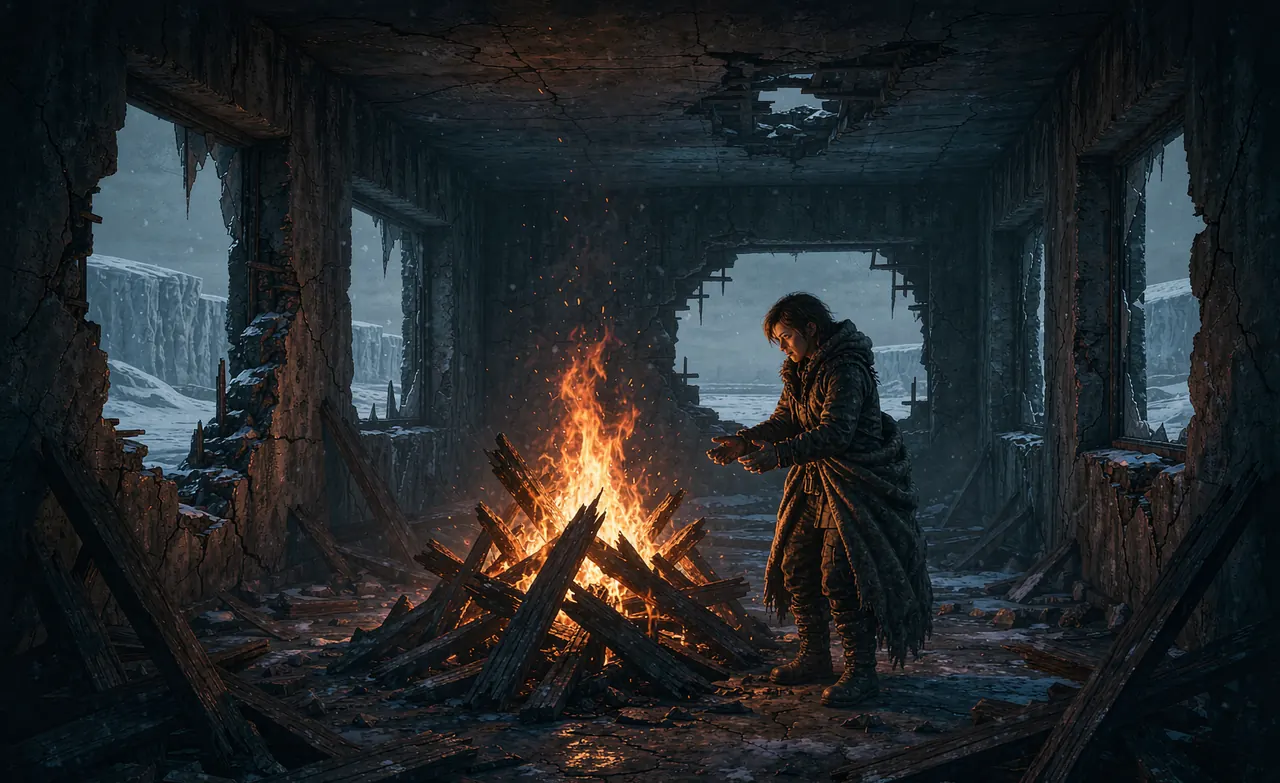
Permafrost is not a game about fighting the cold. It is a game about not being exposed to it. Every decision below follows from that single premise, and all of it comes from what the developer has actually said about the systems — not from an assumed genre template.
The three clocks you are actually managing
New players lose runs in Permafrost for one reason: they treat it as a game with one timer. It has three, and they run at different speeds. Learning to read all three at once is the whole skill.
| Clock | What it measures | What happens if you ignore it | How you buy time |
|---|---|---|---|
| Exposure | How long you have been outside and how cold it is while you are there | Frostbite, then the run ends — fast, and usually far from home | Clothing layers, a nearer shelter, shorter hops |
| Body | Hunger and exhaustion accumulating in the background | You are at full warmth and still useless — no stamina to retreat, no carry capacity | Eat before the deep run, not after; sleep on a schedule |
| Progression | Exploration-gated unlocks: restored shelters, repaired machines, reclaimed technology | You survive week one beautifully and can never leave the starting area | Every trip has one unlock objective, not just a loot objective |
The trap is optimising one clock at the expense of another. Sitting in a warm shelter solves exposure and body while the progression clock stalls. Grinding a long expedition solves progression and burns the other two. Every plan below is an attempt to move all three at once.
Step 1 — Restore, do not build
The single most common mistake in survival games is building a base before you can afford one. Official copy makes this explicit: progression is exploration-gated, and it runs through restoring abandoned shelters, repairing broken machines, and reclaiming fragile technology.
A ruined perimeter already has walls. Repairing it costs a fraction of building the same enclosure from scratch, and scarcity is described as severe. So the rule is: your first shelter is one you find, not one you make.
Step 2 — Put the heat in the middle
Generators are described as the heart of a shelter. Placement is therefore a design decision, not decoration: a generator on the perimeter loses heat to the outside and is exposed to storm damage. Put life support and power deep inside, and build a small “warm room” you can retreat into during a whiteout rather than running heating at full output all night.
That distinction — continuous heat versus retreat heat — is the difference between a fuel economy that works and one that collapses in week two.
Step 3 — Dress for the trip, not for the weather
Clothing is your direct answer to frostbite and the creeping chill, and official guidance points at repurposed industrial gear reinforced with hides and furs. The practical reading: layering exists because exposure accumulates over time. You are not dressing for the temperature on screen, you are dressing for how long you intend to be outside.
Before any long crossing, check the clothing category and treat insulation as expedition planning.
Step 4 — Let the dog do the scouting
Your dog scouts ahead, warns of danger and carries supplies. In practice it solves three problems at once: vision in enclosed terrain, early warning, and carry capacity. If you are going into ice forest or ruins — anywhere your sightline stops at ten metres — the dog is the reason you find the threat before it finds you.
Full breakdown on the dog companion guide.
Step 5 — Plan the route around shelters, not distance
Because cold is ever-present, the shortest line between two points is rarely the safest. A network of restored shelters turns a deadly crossing into three short hops with warm checkpoints, which is exactly what “build a network of shelters to outlast the cold” is describing.
Step 6 — Hunt on the way back, not on the way out
Hunting produces food and the hides and furs that upgrade your clothing. But a successful hunt adds weight, and weight changes how quickly you can retreat. Do it on the return leg, when a full pack costs you less.
Your first 60 minutes, in order
Pre-launch, nobody can give you exact distances or spawn rates. What can be given is a sequence, because the sequence is dictated by the systems the developer has described — not by numbers.
| Phase | Objective | Why this order |
|---|---|---|
| 0–10 min | Orient: find the nearest structure, any structure | Sightlines are short and the cold is already ticking. Structure beats scenery. |
| 10–25 min | Claim it and get a heat source running | You now own a reset point. Everything after this is recoverable. |
| 25–40 min | Short loop around the shelter for immediate materials only | Carry capacity is finite; the first loop should be short enough that a storm does not catch you out. |
| 40–60 min | One clothing upgrade, then stop | The first upgrade converts exposure time into usable range. That is the bottleneck. |
| After 60 min | Scout a second shelter and mark it as fallback | A single-shelter network is not a network. Two points make a route. |
The resource that actually decides runs
Most survival games make their early economy about the plentiful thing — wood, stone, fibre. Permafrost's official framing points the other way: scarcity is the design pressure, and batteries are called out as the scarce high-value resource that powers reclaimed devices and advanced machinery.
That single fact should reorder your priorities, because a scarce, non-renewable-on-demand resource behaves completely differently from a renewable one:
- Never spend it on comfort. Anything a fire or a clothing layer can solve should be solved by a fire or a clothing layer.
- Spend it on capability, not capacity. A device that opens a new zone changes what you can do. A device that does the same thing slightly faster does not.
- Stockpile before you need it. A renewable resource can be gathered reactively; a scarce one has to be banked in advance, which means carrying it home even when your pack is full.
Five ways a first run ends
These are inferred from the described mechanics, not measured — treat them as failure patterns to watch for on 9 October rather than as confirmed behaviours.
- The long walk home. Exposure is cumulative, so the return leg is always more dangerous than the outbound leg. Players plan the trip out and improvise the trip back. Plan the return first.
- The unbanked battery. Carrying scarce resources around in a pack instead of dropping them at the shelter means one bad death costs a week of progress.
- The warm but stalled base. A comfortable shelter with no repaired machines is a very pleasant way to make no progress. Attach one unlock objective to every expedition.
- The ignored dog. The dog is described as scouting, warning and carrying. Leaving it behind removes your early-warning system in exactly the terrain where sightlines fail.
- The single-shelter network. One warm point is a spawn; two is a route. Runs collapse when the only warm point is behind a storm.
On 9 October: a 30-minute verification routine
This guide is written against the pre-launch information set. When Early Access opens at 12:00 UTC on 9 October 2026, spend the first half hour replacing assumptions with measurements rather than playing normally:
- Time how long you can stay outside in your starting clothing before the cold becomes a problem — that number anchors every route you will ever plan.
- Find the first clothing upgrade and re-time the same exposure. The delta tells you whether insulation is linear or has breakpoints.
- Count the fuel a heat source consumes over one in-game night. Fuel economy decides base design more than layout does.
- Pick up the dog and confirm what it actually carries versus what it only scouts.
- Note the first machine you repair and what it unlocks — that is the shape of the progression gate.
Every measurement gets logged to the changelog and folded into the cold survival estimator, which publishes its coefficients openly so you can check the maths yourself.
Before you start: check the hardware question
Permafrost asks for 16 GB RAM at minimum — a high floor for the genre. If you are unsure, run the PC requirement checker first; it takes longer to refund a game than to check a spec sheet.
What this guide deliberately does not tell you
- Exact warmth values per clothing layer — not published
- Generator fuel burn rate — not published
- How fast hunger and exhaustion drain — not published
- Which biome is “best” to start in — depends on values nobody has measured yet
Those four get answered on 9 October 2026 and recorded on the changelog. The decision rules above hold regardless of what the numbers turn out to be.
First-winter checklist
Tick items off as you play — progress is saved in this browser only.
Data version 2026.09.24 · reviewed 24 September 2026.