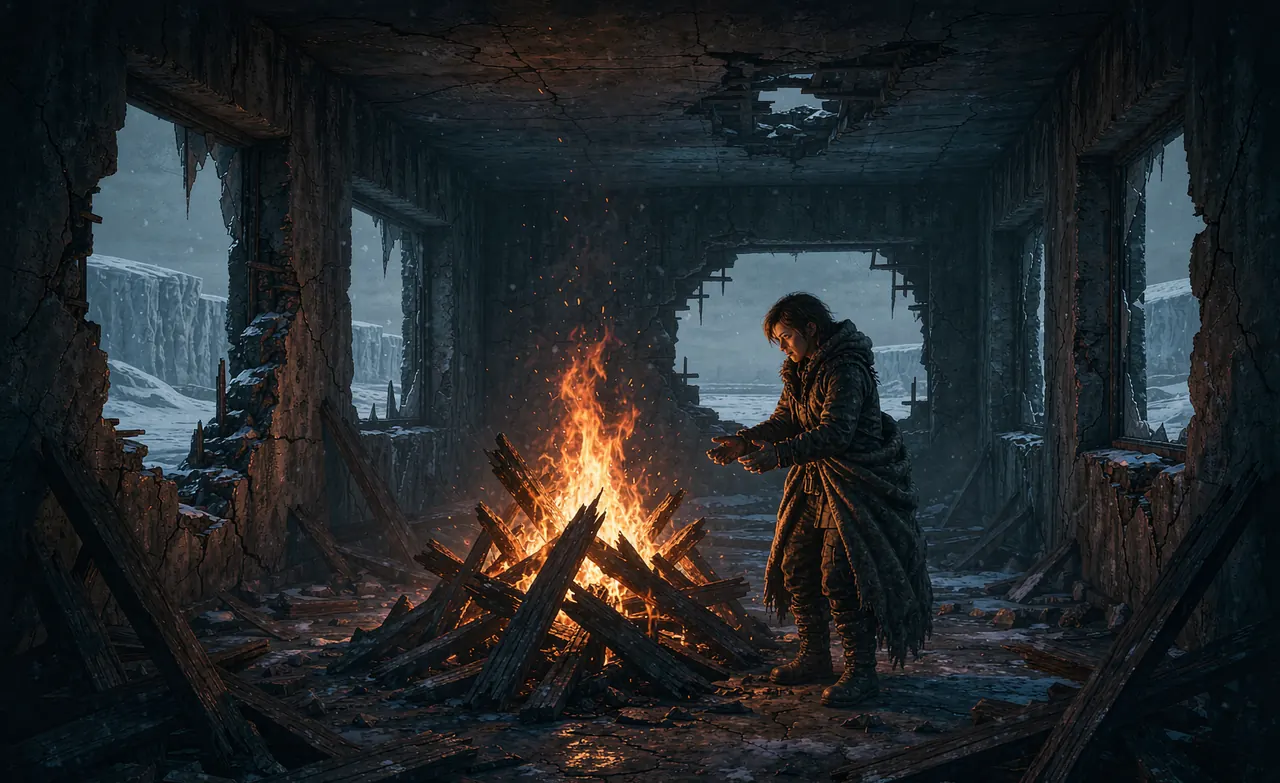
The base is the only thing in a survival game that compounds. Every other action is spent; a finished shelter pays out forever. That is why base building is not a late-game luxury in Permafrost — it is the decision that decides whether a run has a second week.
The first decision: repair or raise
Permafrost's frozen world is full of abandoned structures, and official material frames base building as two options: repair what is already standing, or raise your own. These are not cosmetic variants — they cost different currencies.
Repair a ruin
Costs time and tools, not materials. You get a structurally sound shell immediately — walls, roof, a doorway that already closes.
Correct when: it is the first week, you are salvaging near a cluster of ruins, and your bottleneck is materials rather than time.
Raise your own
Costs salvage and hauling, but you choose the site. Placement is the one thing you cannot fix later.
Correct when: you have a stockpile, you know which biome you are farming, and the nearest ruin is in the wrong place.
A base is a heat machine with rooms attached
Most survival-game bases are designed as storage with a bed in it. That model fails here, because the cold is described as alive and ever-present rather than as weather that passes. A Permafrost base has one job — convert fuel into survivable indoor time at the lowest possible rate — and every room is in service of that.
| Zone | Position | Function | Common mistake |
|---|---|---|---|
| Warm core | Centre, fewest external walls | Generator, life support, sleeping | Putting the generator against an outside wall, where heat leaks and storms can damage it |
| Middle ring | Between core and perimeter | Workbenches, storage, crafting | Heating workspaces you only use for a few minutes a day |
| Buffer / airlock | At the only entrance | Stops outside air arriving with you | Building two doors, or a door that opens straight into the warm core |
| Warm room | Small, heavily insulated, off the core | Retreat space during whiteouts | Sizing it for the group's ambition instead of the group's size |
The warm room is the piece most players skip, and it is the one that changes the economics. Heating a whole shelter through a storm is a continuous drain; heating one small room hard for a few hours is a burst. Over a winter, burst heating beats continuous heating by a wide margin — which is why the heated volume, not the building's footprint, is the number to keep small.
Why repair is a base-building decision, not a chore
Because progression runs through restoring shelters, repairing broken machines and reclaiming fragile technology, maintenance is on the critical path. There is no version of this game where you finish the base and stop repairing.
Degraded structures cost heat before they cost anything else. A wall that has lost insulation is a fuel bill you pay silently, every hour, until you notice it.
Machines are gates, not amenities. A broken machine you have not repaired is content you have not unlocked. Repair targets should be chosen for what they open, not for how convenient they are.
Repair tools are a permanent line item. Keep a dedicated repair kit at the base and a second one in the pack. Discovering you need one at the far end of a route is how gear is lost.
Faction-controlled territory changes the calculus. Official material refers to faction-controlled areas, which means some sites may carry a contest cost that a marginally better location does not justify.
What to site a base on
Four constraints decide a site. In cold-survival games, the first two are non-negotiable and the last two are what most players forget.
- 01
Between two biomes, not inside one
A base inside a single biome optimises one salvage loop and cripples the other three. Site it on a border so two loops stay short. Distance is the resource you spend every single trip.
- 02
Wind cover beats views
Exposure is a heat tax you pay whether or not you notice it. A site tucked behind a ridge or a standing wall costs you nothing and saves heat every hour. High ground is nice to look at and expensive to live on.
- 03
Room to expand
The shelter that fits four players at launch will not fit four players and six months of salvage. Leave flat ground on at least one side.
- 04
A water-adjacent but not water-trapped position
Ice and thaw cycles are a Permafrost theme. Close enough to harvest, far enough that a thaw does not flood your floor.
Insulation comes before storage
New players build storage first because a full pack feels like the problem. It isn't. Cold is the problem, and cold is what makes you lose the contents of the pack.
The build order that survives: seal the shell → heat source → dry storage → crafting stations → expansion. Note that dry storage comes before crafting. Wet materials and wet components are a slow leak that most runs never diagnose.
The 80% rule. A shelter that is 80% sealed and warm today beats a shelter that is 100% finished in three days. Every hour spent building without heat is an hour spent losing heat. Finish the door before you start the second floor.
What is still unmeasured
- Whether building is grid-based, free placement, or snapped to ruins.
- Whether structures decay over time or persist indefinitely between sessions.
- Whether hostile survivors or wildlife can damage structures, and how much.
- Whether generators are required for higher crafting tiers or are optional.
- How many bases a single save supports — one, or a network.
These get measured the week of 9 October 2026 and this page will be updated in place. See Data & sources for the method.
FAQ
Can you build a base anywhere in Permafrost? +
Official material describes base building as repairing abandoned shelters or raising your own, but the placement rules have not been published. Treat "build anywhere" as plausible but unconfirmed until the 9 October 2026 build is playable.
Is it better to repair an existing shelter or build new? +
Repairing is almost always correct early. It converts time into shelter, while building converts salvage into shelter. Early in a run you have more time than salvage. Later that inverts — which is when you build.
How many bases should a 4-player group have? +
One main hub plus one forward cache per biome you farm. The cache does not need to be warm — it needs to be dry, defensible and on the route.
Does the base need power? +
Generators appear in official material as repairable equipment. Whether power is required for crafting tiers or optional quality-of-life is not disclosed.
Data version 2026.09.24 · reviewed 24 September 2026.