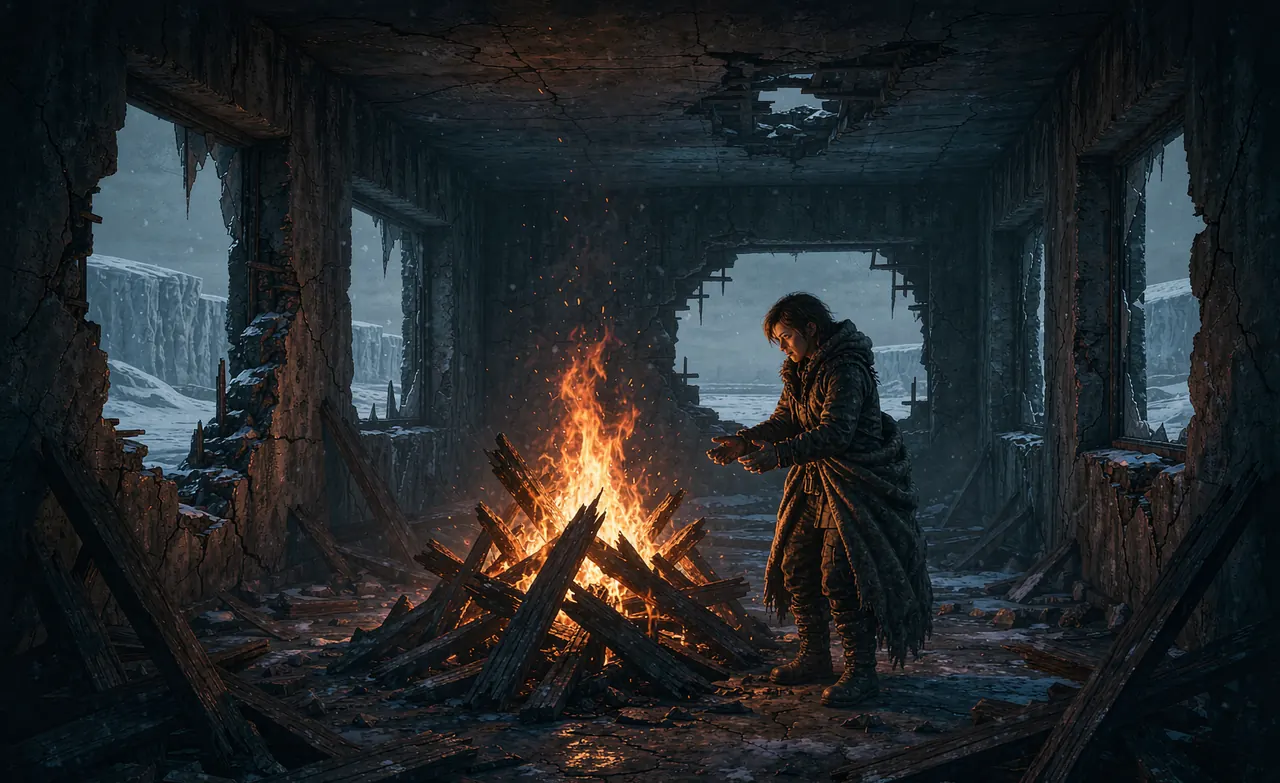
Our first-winter guide covers the whole opening week. This page answers the narrower question players actually search after their first death: what do I do in my first two hours? It was revised after Early Access launched on 9 October 2026 and draws on community-verified play from the first week, not just pre-launch material.
The five stats you are managing
The HUD tracks five attributes plus status effects, and they interact. Hovering any debuff shows how to remove it — read that tooltip before you panic-craft.
| Stat | What it does | What matters |
|---|---|---|
| Temperature | Your resistance to the cold. Below what your clothing can handle, it starts draining | At zero, you start losing health until you warm up — or die |
| Health | The standard life bar | At zero, death and a corpse run |
| Hunger | Drains constantly; at zero, you take penalties | Canned rations restore it without a cooking station |
| Energy | Your sleep need | You cannot sleep while cold — the detail that shapes your first base |
| Stamina | Short-term energy for sprinting and heavy actions | At zero you cannot sprint away from wildlife; it refills |
Heat rules that shape your first base
Three community-verified rules answer most first-night questions:
- Campfires and wall-mounted torches both heat rooms. Wall torches are among the few that actually count as a heat source — useful for small interiors where a campfire does not fit.
- You don’t need heat during the day indoors, but you do to sleep at night. Since a cold character cannot sleep, your bed needs a fire nearby. Keep a fuel stockpile (wood) at your base for exactly this.
- Settlements are warm and free. Inhabited settlements hold enough heat that your temperature is safe there — no fire management required. Use them as rest stops between runs.
Outdoors, the rule is clothing: every piece you wear adds up to a minimum tolerable temperature. Below that, your temperature bar drains. And the one thing you must never do is linger in a Cold Zone — pockets of extreme cold that kill fast, then make you hike back from a safe respawn to recover your body.
The day-one routine
Community consensus from the first week converges on one ordered checklist. The order matters because night arrives whether you are ready or not:
- Grab loose wood, rocks and roots around your spawn. No tools needed — this is free material.
- Craft the stone axe and stone pickaxe. These two unlock everything else.
- Find a ruined structure near spawn — intact walls are warmth and safety you don’t have to build.
- Get it enclosed before the temperature becomes a problem. A finished wall matters more than a pretty base.
- Campfire, fuel pile, cook your food. Stack enough wood beside the fire to cover the night — and remember you need it to sleep.
- Place a stone furnace and start toward copper if resources allow. Then stop. Nothing good happens to a dying character at midnight.
The tool ladder — know it before you mine
Tool progression is strictly gated: stone → flint → copper → iron. Each tier of pickaxe is required to harvest the next tier of material — a flint pick mines copper, a copper pick mines iron. Don’t spend your first evening hunting copper with a stone pick; it does not work. Basic resources like wood and stone are abundant — do not grind hundreds of them on day one.
Your dog, and the first blizzard
You rescue the dog companion early, and it earns its slot three ways: it warns you of nearby threats, detects hidden things, and adds carrying capacity — effectively extra inventory on long scavenging runs. One launch-week caveat from community reports: its pathfinding is rough. It gets stuck behind doors and struggles with stairs. Plan around it, don’t build around it.
When your first blizzard hits, the right move is to not push through it. The rest mechanic makes waiting genuinely worthwhile: eat, rest in your shelter, and let the storm pass. Permafrost rewards treating bad weather as an event you sit out, not a challenge you brute-force. That mindset — prepare before the cold forces you to — is the whole game in one sentence.
Data version 2026.10.12 · reviewed 12 October 2026. Revised 14 October 2026 against Early Access launch-week play. All numbers intentionally omitted until measured in the live build.